
Sonia-ProQ
Sonia-ProQ (Soybean Observation using NIRS for Attribute-Depending Prospective Quality Management) supports farms and soy processors in the utilisation of domestic soybeans for the production of animal feed. The project is doing pioneering work in the field of real-time process control in the treatment of soya beans. Technical optimisations based on near-infrared spectroscopy and imaging methods improve the product quality of soya products and the economic efficiency of processing. Together with accompanying measures such as a feeding trial with fattening pigs and a comprehensive training programme, the project is sustainably strengthening a large number of farms and contributing to improving the resilience of deforestation-free supply chains in Austria.

Project consortium
This project is coordinated by Josephinum Research in Wieselburg, Austria.
The partners are:
- AGES – Österreichische Argentur für Gesundheit und Ernährungssicherheit
- BOKU – Universität für Bodenkultur
- Donau Soja
- EST GmbH
- HAUP – Hochschule für Agrar- und Umweltpädagogik
- i-RED Infrarotsysteme GmbH
- Josephinum Research
- MH-Agrarhandel GmbH
- oilpress GmbH & Co. KG
- Saatbau Linz eGen
Project summary
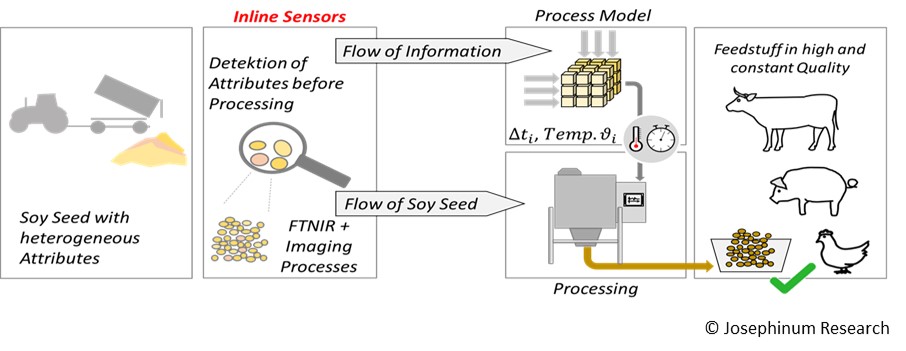
The Austrian demand for soy amounts to about 600,000 tons per year. Around 80 percent is imported genetically modified (GM) soy from overseas. Austria aims to reduce its soybean import demand by 50 percent by the year 2030. On the one hand, this goal requires an expansion of the cultivation area and an increase in processing capacity. On the other hand, a demand-reducing effect can be achieved by increasing the processing quality. The main task of soybean processing is to break down antinutritive substances (trypsin inhibitors, saponins, lectins) while preserving valuable ingredients such as proteins as much as possible. This generally complex process control is complicated by the fact that necessary process adjustments only become apparent in the processed product (post-processing). Especially the regional decentralized processing of soy offers great potential to meet the increasing demand for processing capacity. In addition, small-scale plants have the potential to compensate fluctuations in quality caused by the feedstock. An increase of the processing quality in this way, this will have a demand-reducing effect.
The aim of Sonia-ProQ is to develop a suitable and practical solution for the acquisition of relevant properties in the preparation process. The data acquisition is the basis for the currently developed model from “Model-S”. The acquisition is to be realized with NIR-based sensor technology combined with imaging techniques. The main advantage is the non-contact and substance-preserving detection of the soybean in real time. The challenge in Sonia-ProQ is to make defined properties of the untreated bean quantitatively detectable by NIRS and imaging techniques and available for subsequent modeling. The innovative approach and the unique possibility of prospective process control promotes a resource-saving and sustainable production of high-quality Austrian soy products. A successful implementation of Sonia-ProQ provides a valuable contribution to the Austrian goal of reducing soy imports and at the same time enables an increase of the Austrian added value.
Project duration: October 2023 – September 2025
Long-term Monitoring of Decentralised Soybean Processing Plants Using In-Line NIRS Sensors
Soybeans are an important protein source in animal nutrition due to their high content of essential amino acids and their high biological value. However, for feeding monogastric animals such as pigs and poultry, thermal treatment is required to reduce antinutritional factors, particularly trypsin inhibitors. The aim of soybean processing is to sufficiently reduce trypsin inhibitor activity (TIA) while minimising damage to valuable nutrients such as proteins and amino acids [1, 2, 3].
In decentralised processing plants, thermal treatment is mainly carried out by roasting. Process control currently relies primarily on wet chemistry analyses or laboratory investigations using near-infrared spectroscopy (NIRS) [4, 5, 6]. Although these methods provide important information about product parameters such as TIA, protein solubility in potassium hydroxide (KOH-PS), crude protein content, and residual fat content, they have one major disadvantage: there is a significant time delay between sampling and obtaining analytical results. As a consequence, process deviations are often detected and corrected too late. Protein feed that has not been properly processed can lead to a decline in animal performance. The production of high-quality protein feed therefore requires not only rapid analytical results but also the necessary expertise to correctly interpret these results and implement optimal process adjustments. Within the research project “Sonia-ProQ”, these central aspects were addressed and implemented. The results are presented below.
To accelerate data acquisition, a novel real-time monitoring system for soybean processing was developed. The core component is an in-line NIRS measuring unit integrated directly into the product flow, continuously recording relevant process parameters such as TIA, KOH-PS, crude protein content (XP), and residual fat content (XL). This measuring unit was tested and optimised over several months in soybean processing plants. Wet chemistry reference data obtained from regularly collected product samples were used to develop corresponding chemometric models.
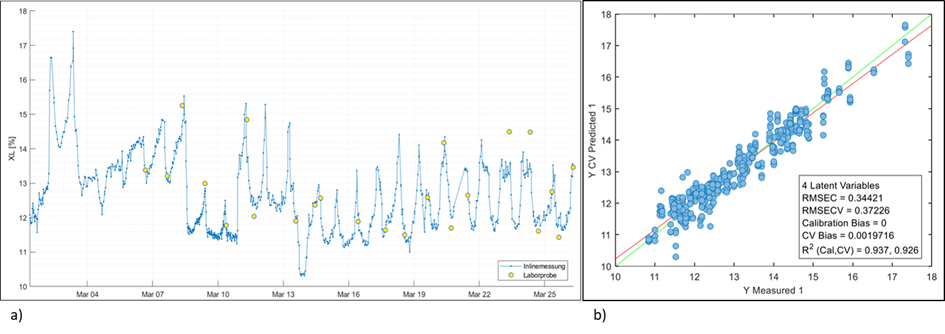
Figure 1: Results of the analysis of residual fat in soya cake. a) Comparison of results between wet chemical analysis of individual samples (yellow) and in-line NIR data acquisition (blue). The high density of measurement points using NIR provides a detailed picture of fluctuations in the process. Furthermore, this data can be made available in real time. b) Results of the chemometric model for residual fat chttps://legumehub.eu/wp-content/uploads/2026/05/SONIAproQ_Image.pngontent. An R²CV of 0.926 was achieved during the project period
Figure 1 presents one example of the results obtained with the in-line NIRS measurement system for residual fat analysis in soy cake. While laboratory analyses provide only isolated measurement points (yellow dots), continuous real-time measurements (blue line) enable a much more detailed representation of process fluctuations. The developed prediction model for residual fat content, shown in Figure 1b, achieved a coefficient of determination of R²cv = 0.926.
The results demonstrate that a high analysis frequency is essential for optimal process control. In-line NIRS technology enables continuous real-time quality monitoring and therefore offers considerable potential for improving product quality as well as the economic optimisation of decentralised soybean processing plants.
In order to evaluate animal performance when using optimally and suboptimally processed soya protein feed, a feeding trial involving fattening pigs was carried out as part of the project. The animals were divided into three groups: one group was fed a ration containing optimally processed protein feed, one group was fed suboptimally processed protein feed, and one group was given free choice between rations containing both types of protein feed.
It was found that the group fed the optimally processed protein feed achieved better fattening performance. However, the group with free choice of feed was able to partially offset this effect.
An other major objective of the research project focused on the preparation and transfer of fundamental knowledge regarding soybean processing. Comprehensive expertise is essential for plant operators in order to correctly interpret analytical results and optimise processing conditions accordingly. For this purpose, a part-time university training course was developed and implemented specifically for soybean processing plant operators. In addition, open-access online webinars were offered to provide basic information on soybean processing technologies. Furthermore, information sheets summarising the most important background knowledge as well as short educational videos were produced.
References
- Nassir, O.A. Investigation into the nutritional evaluation of differently treated soybeans in broiler nutrition. Georg-August University Göttingen, Dissertation, 2001.
- Freitag, M., Ludwig, E., Südekum, K.H. Methods for reducing protein degradation in the rumen. Domestic grain legumes with protected protein in dairy cattle nutrition. UFOP Publications, Issue 33, pp. 2–14, 2007.
- Trimmel, M., Eder, E., Riegler-Nurscher, P., Schedle, K. (2022). Prospective Thermal Processing of Soybeans Using a Bean Characteristic Model. In: AgEng LAND.TECHNIK 2022, pp. 541–548. DOI: 10.51202/9783181024065-541.
- Araba, M., Dale, N.M. Evaluation of Protein Solubility as an Indicator of Underprocessing of Soybean Meal. Poultry Science, Vol. 69, pp. 1749–1752, 1990.
- Parsons, C., Hashimoto, K., Wedekind, K., Baker, D. Soybean protein solubility in potassium hydroxide: An in vitro test of in vivo protein quality. Journal of Animal Science, Vol. 69(7), pp. 2918–2924, 1991.
- Hoffmann, D., Brugger, D., Windisch, W., Thurner, S. Calibration Model for a Near Infrared Spectroscopy (NIRS) System to Control Feed Quality of Soy Cake Based on Feed Value Assessments In-Vitro. Chemical Engineering Transactions, Vol. 58, pp. 379–384, 2017.

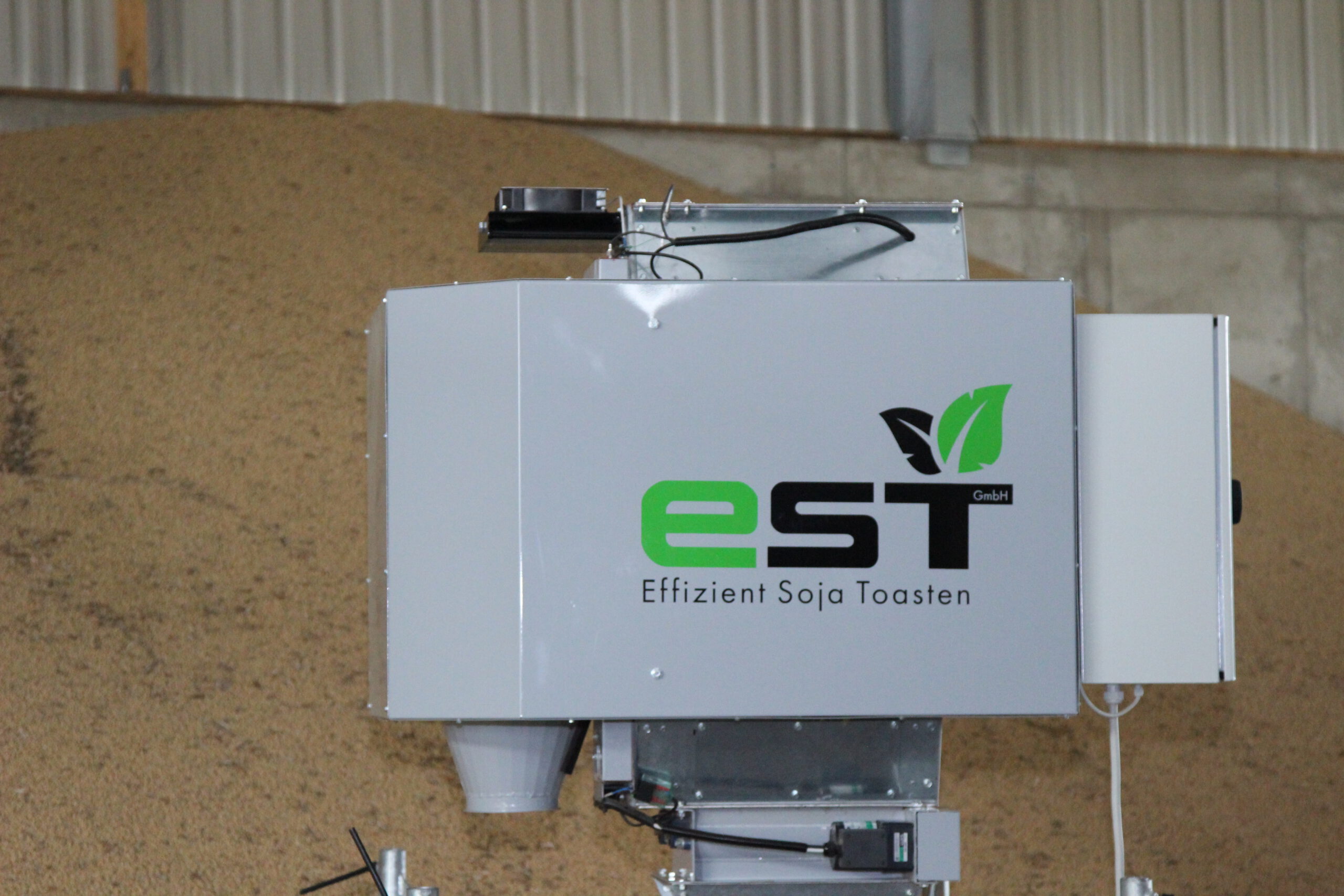
© EST GmbH
Acknowledgements
Sonia-ProQ (Soybean Observation using NIRS for Attribute-Depending Prospective Quality Management) has received funding from FFG – COIN KMU-Innovationsnetzwerke 2022.